






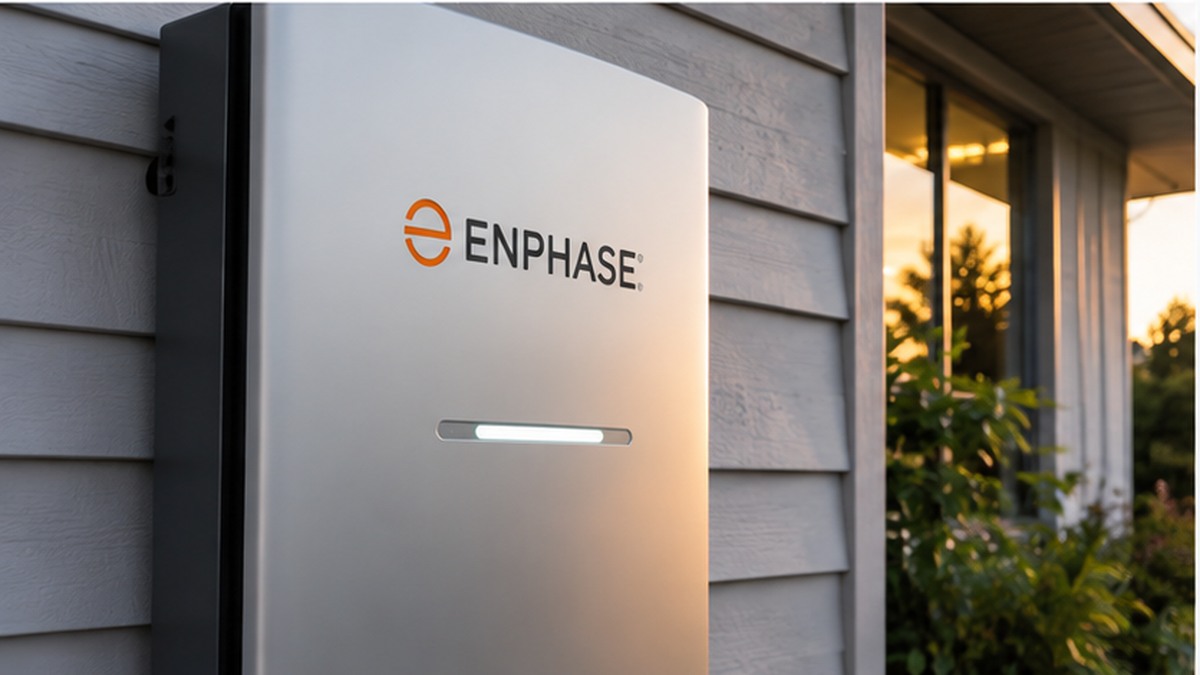
For decades, the standard response to a power outage was simple: find the flashlights, listen to the refrigerator get suspiciously quiet and hope the utility company arrives before the ice cream surrenders. Enphase thinks the future should be a little more sophisticated. At the RE+ 2026 show, the company is highlighting a new home battery and technology intended to let a compatible electric vehicle help power a house.
The IQ Battery G5 uses stackable 5-kilowatt-hour AC-coupled modules. Enphase says a stack can reach 30 kWh, with installations scaling to as much as 100 kWh. Each module includes a grid-forming microinverter, a key piece of the equipment needed to keep a properly configured home system running when utility power is unavailable. The company lists a 15-year limited warranty.
Then there is the IQ Bidirectional EV Charger. Instead of treating an electric vehicle as a one-way destination for electricity, a bidirectional charger can—in a compatible installation—allow energy to flow back toward the home or grid. That could turn the large battery already sitting in the driveway into another source of resilience. Of course, vehicle compatibility, installation hardware, local rules and actual supported functions all matter. You cannot assume every EV will suddenly become a whole-house generator.
The appeal is easy to understand. A dedicated home battery is useful, but a vehicle may carry substantially more stored energy. Pairing the two could help households prioritize essentials during an outage or shift electricity use away from expensive hours. It also raises practical questions: how much range are you willing to sacrifice to keep the air conditioning running, and what happens if you need to leave in the middle of a blackout?
Enphase says pilots for both the G5 battery and its DC-based bidirectional charger are expected in late 2026, with volume shipments planned for the first quarter of 2027. Those are company targets, not confirmation that products are available everywhere today. Prices, installation requirements and real-world compatibility will be the deciding factors for homeowners.
The larger trend is encouraging. Backup power is moving beyond noisy engines and fuel cans toward combinations of solar panels, batteries, smart controls and electric vehicles. A gasoline generator still has advantages in some situations, especially during extended outages. But having several ways to keep the lights on sounds better than betting the entire house on one solution.
What do you think? Would you use your EV battery to power the house during a blackout, or would you rather keep every mile of range available for an emergency?