






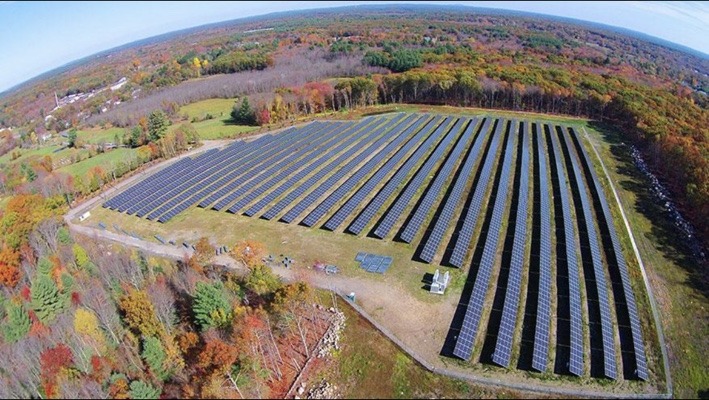
What do you do with a piece of property that has spent years collecting everybody else’s garbage? In Holliston, Massachusetts, the answer is apparently to turn it into a power plant. The town and Onyx Renewables announced November 23 that a solar installation with battery storage is operating on a closed municipal landfill. Of all the places we could be putting solar panels, a piece of land that has already been disturbed and isn’t particularly well suited to ordinary construction strikes me as a sensible choice. According to the announcement, nearly 5,700 panels provide 3.4 megawatts of rated generating capacity, with 2.75 megawatt-hours of battery storage. Onyx developed the facility and will own and operate it, while the town expects ongoing revenue from the arrangement.
Those two numbers describe different things, incidentally. Megawatts tell us about power, while megawatt-hours tell us about energy. The battery’s storage figure doesn’t tell us by itself how long it can power a particular load, because that depends on its available charge, discharge capability and the demand being served. What the battery does provide is an opportunity to use some of the solar energy at a time other than when the sun happens to be cooperating. And putting the equipment on a landfill isn’t simply a matter of hauling in a truckload of panels and digging holes wherever you please. Protecting the landfill cap and maintaining environmental safeguards are important parts of making the project work.
I like projects that make productive use of property we already have rather than pretending every new installation needs a pristine piece of land. This one isn’t going to solve everybody’s energy problems, nor does it need to in order to be worthwhile. If a town can take property with limited development options, generate electricity and bring in some revenue without compromising the safeguards that are there for a reason, that sounds like a pretty good use of yesterday’s garbage dump to me.