






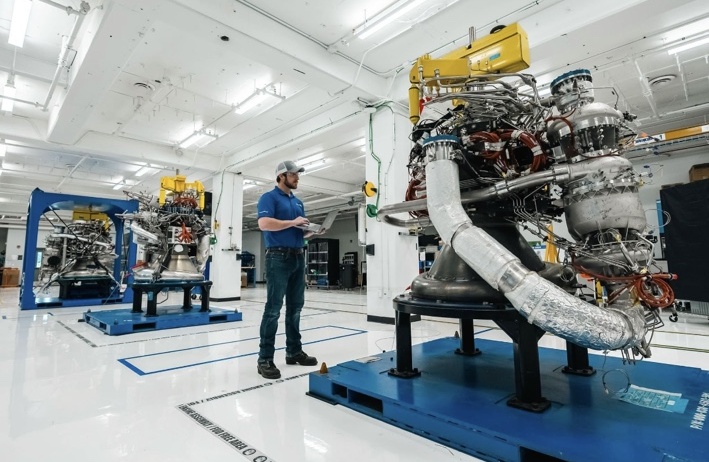
As somebody who enjoys 3D printing, I find it hard not to get excited about a rocket engine built using the same broad manufacturing philosophy as the machines sitting in hobbyists’ workshops. Blue Origin introduced its Northstar booster engine on November 5, and renewed coverage makes this a good opportunity to look at what the company is attempting. Northstar is a liquid oxygen and liquefied natural gas engine, and Blue Origin says additive manufacturing accounts for more than 65% of its production. That does not mean a desktop printer could produce a working rocket engine. It does mean that building complex objects by adding material, rather than cutting or casting every feature separately, is transforming some of the most demanding engineering in the world.
The company reports 715,000 pounds-force of thrust, compared with 640,000 for the BE-4 reference engine, along with a 30% mass reduction and half as many parts. Those figures are manufacturer claims, not my own test results. What catches my attention is the combination of changes. A lighter engine that produces more thrust is attractive in a vehicle where every pound matters, and fewer components could reduce the work required to assemble it. But the percentage produced additively needs to be understood as the company reports it; it does not establish that every component is printable or that the finished engine comes straight out of a machine ready for flight. There is a great deal of engineering between producing a metal shape and trusting it with a rocket.
For anyone who has spent an evening trying to make a plastic part fit correctly, the appeal of additive manufacturing is familiar. You can change a design on a computer and produce another version without paying for a new mold. Engineers can also create internal passages and shapes that would be difficult or impractical to manufacture using conventional methods. In metal manufacturing, different processes deposit or fuse material using carefully controlled energy sources. The material, equipment and process depend on the part. The ability to make complicated geometry opens the door to combining features that once required several separate pieces. A simpler assembly can mean fewer joints and fewer opportunities for mistakes, although the resulting component still has to meet demanding specifications. That is a much more interesting achievement than simply printing a recognizable object.
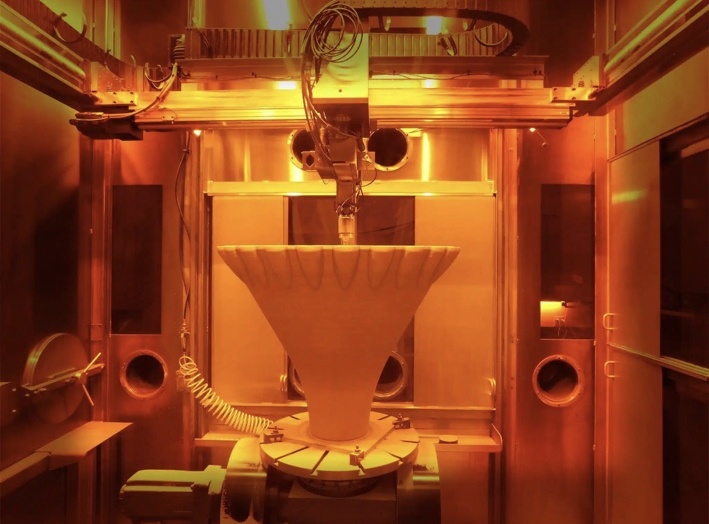
Anyone who thinks the printer does all the work should look at the complete manufacturing process. Metal parts may need heat treatment, machining, surface finishing and inspection. Engineers must understand how the material behaves under loads, heat and repeated use. Internal defects that would be irrelevant in a decorative model can become serious problems in a structure that operates under extreme conditions. A component must be evaluated as a real engineering object, not just admired for looking like the model on a computer screen. Repeatability matters as well. A manufacturer needs to know that the next part will have the required properties, not merely that the first one managed to survive a test. This is where industrial additive manufacturing becomes a very different proposition from printing a phone stand at home.
Blue Origin also says its production improvements allow assembly in less than a day and that the Northstar program reached development testing within 11 months of approval. Assembly time is not the total manufacturing time, and development testing is not flight certification. Nevertheless, a faster path from a design change to a testable engine can be tremendously useful. Engineers learn by making things, measuring them and working out why they behaved the way they did. Reducing the time spent waiting for tooling and assemblies can increase the number of design iterations a team can evaluate. A company that can produce consistent parts and test changes efficiently has an opportunity to learn faster. I find that arguably as exciting as the finished thrust figure.
There is also a broader manufacturing lesson here that has nothing to do with launching a rocket. Low-volume complex parts are often expensive because traditional manufacturing processes require specialized fixtures or tooling. Additive processes can offer another route, especially when the design makes good use of what the process can do. That does not mean every stamped bracket or injection-molded plastic part should be replaced with something printed. Conventional manufacturing can be remarkably efficient when producing large quantities of simple components. The interesting question is where additive techniques provide an advantage that justifies their costs, and whether designers are creating parts specifically to exploit those advantages rather than copying designs intended for another process. Aerospace is a fascinating place to watch that tradeoff play out.
I hope we see more published information about testing, durability and production as Northstar develops. The exciting part of this story is that the company is not merely printing a demonstration model for a trade show; it is pursuing an engine whose design and manufacturing approach are intended to improve real propulsion hardware. Whether the claimed benefits translate into reliable operations remains to be demonstrated over the life of the program. But consider how far this technology has come from making plastic prototypes to being part of a major rocket engine development effort. If you had told me years ago that we would be discussing the percentage of a booster engine made through additive manufacturing, I would have wanted to see the printer immediately. Give this article a like if you share that enthusiasm, and tell me what complicated everyday product you would like to see redesigned around additive manufacturing next.