






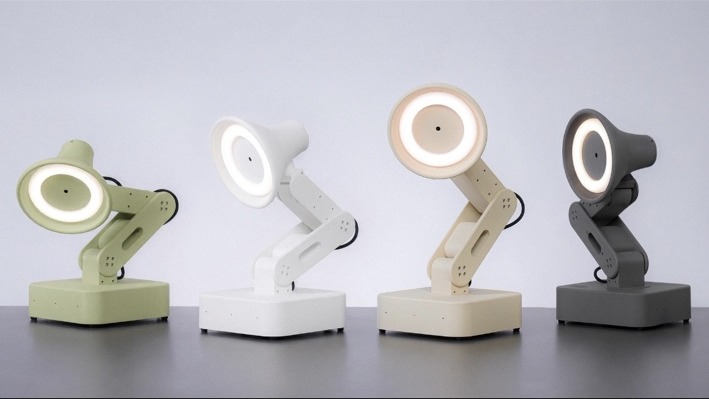
I have purchased a fair number of gadgets over the years, and until recently I never gave much thought to whether my desk lamp was happy to see me. As long as it illuminated whatever I was working on, we had a perfectly satisfactory relationship. Apparently that arrangement is about to become embarrassingly outdated. Researchers and startups are exploring a new generation of household robots that look less like the mechanical people we grew up watching in science fiction and more like the ordinary objects already sitting in our homes. And the more I look at the engineering behind these things, the more I want to play with one.
The idea is not entirely new, but a November 27 Computerworld opinion piece puts a particularly interesting question on the table: do we actually want our appliances to encourage us to become emotionally attached to them? It is easy to laugh at a lamp that seems excited to see its owner, but there is a serious design problem underneath the comedy. A machine that moves around people needs to communicate what it is doing. If those movements can make its intentions easier to understand, the result might be more useful than simply giving a stationary smart speaker another personality setting.
Apple explored precisely that territory in its ELEGNT research project, published in 2025. The researchers built a lamp-like robot to investigate how practical motion and expressive motion can coexist. Think about how a lamp could turn toward the area where you are working, or acknowledge an interaction by changing its posture. The fascinating bit is not the addition of a chat window; it is the possibility that physical movement could become part of the interface. Apple has not announced a consumer product based on this prototype, and I would not start saving space on the desk for an Apple Lamp just yet.
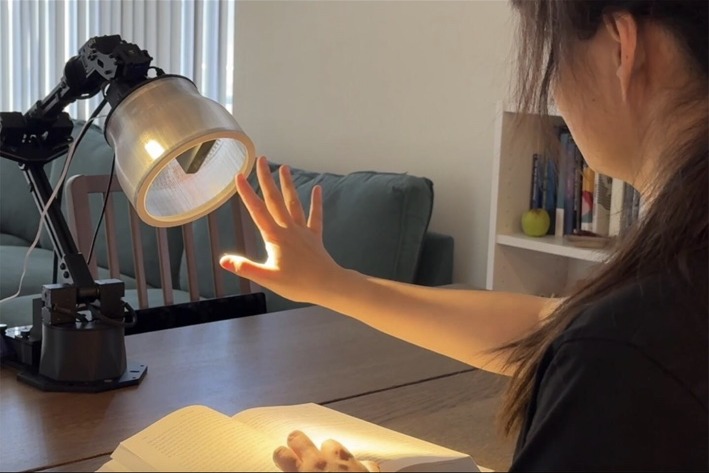
What I like about that approach is that it does not require a humanoid robot. If a device is intended to help me at a desk, why does it need legs, a torso and a face? A few well-designed joints could make it more practical, less intrusive and easier to understand. Imagine working on a small electronics assembly and having the illumination follow the part rather than repeatedly stopping to reposition a lamp with your hands. That is an example of the kind of capability I would want, not a promise that any particular product can do it today.
OKA is approaching the idea from another direction with Mori, a companion robot introduced in October. The company describes a small lamp-like device that uses light, sound and movement to interact with its surroundings. Its emphasis is companionship and a quieter experience in the home rather than doing the dishes. The company’s product page lists an estimated November 30 delivery date for its first-access orders, which is an estimate rather than proof that units have arrived. It is an interesting experiment in making computing less dependent on screens.
I can see why someone might enjoy a device like Mori sitting beside a chair while they read. A little ambient light and an occasional movement might be charming. But I also wonder how long the charm lasts after the novelty wears off. Will I still enjoy having the gadget around in six months? Can I turn off the interactive behavior and simply use the light? Does the hardware continue to work if the company decides that its next business model involves a subscription? Those are the questions I would ask before buying an expensive companion device.
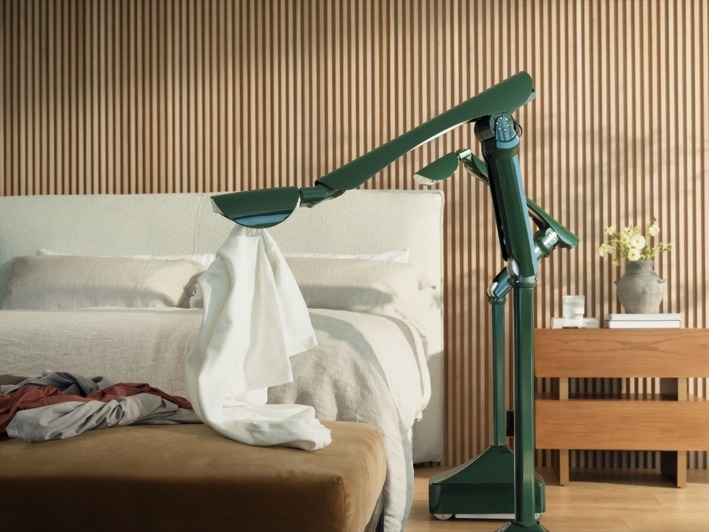
Syncere takes a more ambitious approach with Lume, a floor lamp designed to perform household tasks. Its product page lists a starting price of $2,699 for one unit. The idea of hiding a robot inside an attractive household fixture is clever, particularly if it can actually do something useful when I am not paying attention. The company’s demonstrations and marketing should not be confused with independent evidence of everyday reliability, though. I want to see how it handles a real house, complete with awkward furniture, clutter and laundry that has apparently developed a personal vendetta against being folded.
Now for the part that really gets my attention: the maker community. Human Computer Lab has an open-source project called LeLamp, an expressive robotic lamp with publicly available project materials. Autonomous also offers a lamp platform and publishes software for its system. That gives curious people a chance to explore how these devices work instead of merely waiting for a large manufacturer to decide which features we are allowed to have. For somebody with a 3D printer, a workbench and a dangerous tendency to start another project, this is exactly the sort of rabbit hole that looks interesting.
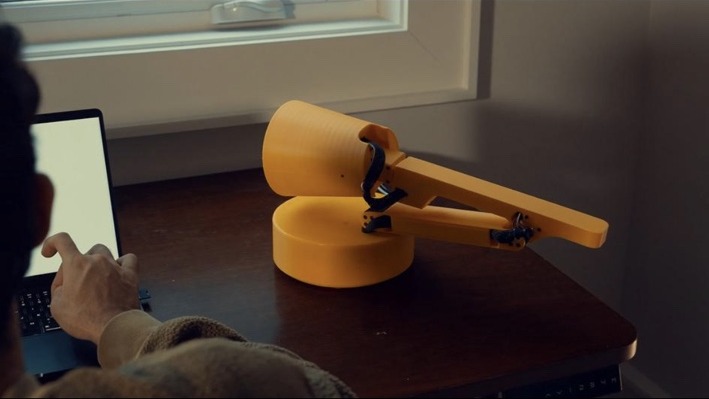
The appeal of printing parts for a robot is that it turns the enclosure and mechanical design into something you can experiment with. A bracket can be changed, a housing can be revised and a joint can be redesigned after discovering that your first brilliant idea was not quite as brilliant as you thought. Of course a printer alone is not enough. Motors, electronics, wiring, appropriate power supplies and software are still needed, and moving joints introduce mechanical and electrical safety considerations. The beauty is that the maker can learn from each iteration.
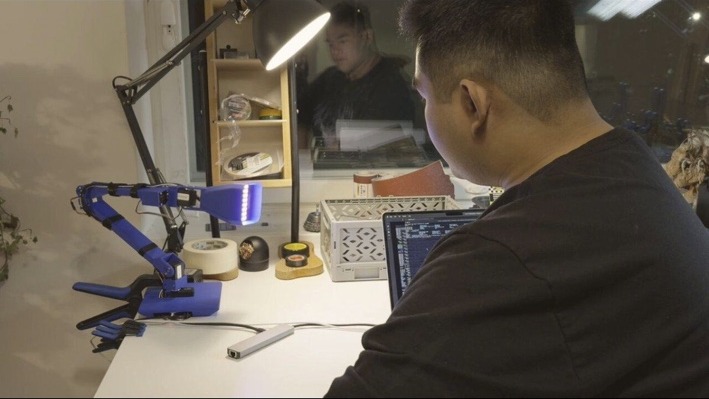
What makes an expressive lamp difficult is not merely making an arm move from point A to point B. It needs to move smoothly, know where it is, avoid collisions and behave predictably near the people using it. A movement that is charming in a demonstration might become irritating if it happens every time you reach for your coffee. Designing a robot that knows when to leave you alone may turn out to be just as challenging as designing one that knows how to get your attention.
Then there is privacy. Some companion devices use cameras or microphones to interpret their surroundings. A robot that can recognize its owner is interesting, but I want to know where that recognition happens, whether recordings leave the device, what is retained, and how I can disable the sensors. A physical camera cover and a clear indication of when microphones are active would make me considerably more comfortable. A device that runs locally where practical also has an advantage if its owner would rather not send ordinary household activity to a remote server.
None of this requires believing that a lamp has feelings. A machine can respond in a way that resembles curiosity, excitement or disappointment without experiencing those emotions. That distinction becomes particularly important when the manufacturer benefits from encouraging people to form a relationship with the device. I am happy to have a little personality in a gadget, but I do not need it to guilt me into paying for a premium subscription because it is apparently lonely.
I am genuinely excited about the possibilities here. I would love a workbench assistant that lights the right spot, recognizes a simple gesture, stays out of the way and lets me modify its behavior. If it occasionally looks disapprovingly at my unfinished projects, I suppose I can live with that. Like this article if the idea of printing your own little robotic assistant has your attention, and tell us what you would build: a practical workshop helper, an entertaining desk companion, or a perfectly ordinary lamp that has the good sense to remain quiet?